
Strategy
Listen before you draw: what audience research can change before design
A logo answers a question. Research makes sure it is the right one.
A logo answers a question. Research makes sure it is the right one.
Most branding projects begin with a reasonable request: “We need a logo.” It is what people see. It goes on the door, the packaging, the profile picture. Paying for research before it can feel like paying for a delay. We understand the impulse. But in almost every project we have worked on, the most valuable thing research produced was not an answer. It was a better question.
The cheapest place to change your mind
Frank Lloyd Wright is said to have told his apprentices that an architect’s two most important tools were “the eraser in the drafting room and the wrecking bar on the site.” The first costs minutes. The second costs buildings.
Brands work the same way. Research and strategy are the eraser: the stage where you can question an idea, test it against the people it is meant for, and discard it before it costs anything. Skip them, and the corrections still happen. They happen in public, with printed packaging, a launched website, and customers who no longer recognize what they used to buy.

Misreading an audience, and listening to one
In 2009, Tropicana replaced its familiar orange-with-a-straw packaging with a cleaner, more modern design. Customers wrote, called, and emailed to say it looked generic. Sales fell about 20%, roughly $30 million, and within six weeks the company brought back the old design.
The new packaging was not badly drawn. It misread what buyers relied on at the shelf: a few familiar signals that told them, in a second, that this was their juice. Understanding which elements people depend on, and why, is exactly the kind of knowledge that should mark them as untouchable before anyone opens a design file.
Listening can also save a brand from its own plans. In 1897, in Orizaba, Veracruz, the German-born brewer Wilhelm Hasse created a beer to welcome the century about to begin. He called it Siglo XX and wrote the century on the label in Roman numerals.
But people did not ask for Siglo XX. In bars and shops, they asked for la de las dos equis, the one with the two Xs. The name on the label meant little to them; they remembered the symbol.
The brewery used the name for a century. Its customers named it for a symbol.
The brewery could have spent years correcting its customers. Instead, it listened, and eventually it adopted the name people were already using. The two Xs that had always been on the label gained meaning from the people who drank the beer. More than a century later, Dos Equis is the name the brand carries worldwide.
Tropicana changed what people relied on, and they lost it. Dos Equis accepted what people had already decided and kept them. Both stories begin in the same place: with what an audience actually does, whether or not the brand is paying attention.

Observation, interpretation, choice
Research is often imagined as a survey that tells you what to do. It doesn’t. It works in three steps, and each one needs a different kind of attention.
Observation. What people do, not only what they say. That is why we practice shadowing: we go with shoppers to the point of sale and watch how they read a label. How long they take to choose. What else catches their eye, what makes them hesitate, who is with them, what they pick up and put back, what they never buy. Which areas of the store draw people in and which they walk past, the hot and cold spots of the space. Each detail is a small piece of evidence for a strategic decision.
Interpretation. Then we ask. In-depth interviews let us revisit everything we have observed and researched, this time from the perspective of the person we hope to win over: what interests them, what leaves them indifferent, what they actually understand from what a brand is trying to tell them. Their answers tell us whether the direction is right or whether it needs to change.
Choice. Finally, the evidence has to become a decision. Over the years, we have developed our own methods of analysis, bringing together disciplines that rarely share a table. Working with clients across very different industries, from fashion and pet care to food and construction materials, lets us cross strategic variables more widely: a behavior we notice in one category often sheds light on another.
Each step protects the brand from a different mistake. Skipping observation produces brands built on a team’s assumptions. Skipping the interviews produces brands that see what people do but never learn why. Jumping from data straight to design produces brands that echo their customers instead of leading them. The value lives in the connection between the three, where watching and listening become a point of view, and a point of view becomes a decision.

Three things research can change
A useful finding does not decorate a project. It moves it. In our experience, it changes one of three things.
The question of the project. A company asks for a new logo, and the interviews show that people do not understand what it offers. The project becomes clarity, not decoration.
The promise. Who the brand is for and why they should care. This is where research meets brand positioning: where a company comes from, what sets it apart, and why that should matter to someone else.
A design decision. A name, a color, an image or a tone of voice, chosen because of something the team heard rather than something it liked.

Why a meaningful difference pays
Kantar, one of the world’s largest brand research firms, measures brands on three qualities: how meaningful, how different, and how salient they are. Its research finds that people who choose a brand first are willing to pay, on average, 37% more. Even price-driven shoppers will pay 14% more for brands with a big, meaningful difference.
Notice the order of those words. Being different is not enough; the difference has to matter to someone. Audience research is for finding that overlap. A logo can express a difference. It cannot discover one.

What the job site taught us
Our clearest example comes from a tile adhesive, Pegachingón.
Observation. On construction sites, we watched the maestros, the master tilers who choose and apply the product every day. They rarely remembered the names of the brands they used. The names were technical and distant, with nothing human to hold on to. What they did remember was whether the adhesive worked, and they had their own way of saying it: a good one pega chingón, a Mexican expression that roughly means it sticks like nothing else.
Interpretation. In interviews, they told us the brands were not speaking to them. The packaging seemed made for engineers and architects, not for the people who actually open the bag. They also described, very precisely, what they needed: a slightly tacky, elastic mix, chiclosito, as they called it, that would not dry too fast and would leave time to work each piece. And they explained how they tested it. A few minutes after laying a tile, they would try to pull it off. If it held, the job was done right, and the product was good.
Choice. Everything we learned went into the brand, and further than we expected. The name came straight from their language. Their own test became the product’s claims and the copy on the package. And their requirements went to the team of chemists and engineers who developed the formula. Research did not just shape how the product looked. It shaped what the product was.
What design gains
When research comes first, design gets faster, not slower. There are fewer rounds of revisions because every option is measured against what people actually need, not personal preference. The team can explain why the brand looks and sounds the way it does, and defend it in any meeting. And the identity can grow because its rules come from insight rather than trend.
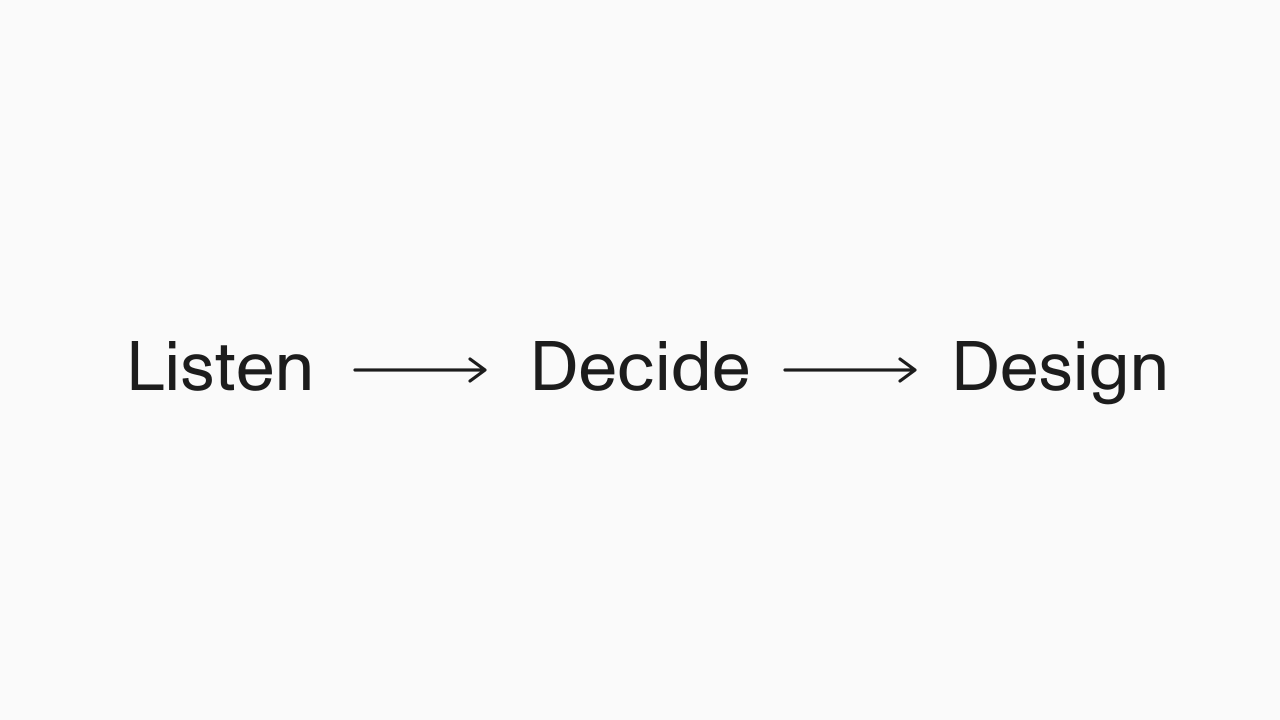
That is why our brand strategy and design work always starts with listening: to the business, its audiences, and the market around them.

The last decision
A logo is the most visible part of a brand, so it is tempting to start there. But what people see at the end is the last of many decisions, not the first. The good ones begin by listening, with an eraser in hand, long before anyone needs a wrecking bar.
Planning a new brand, or rethinking the one you have? We want to start by listening. Start a conversation ↗
Sources
Frank Lloyd Wright, in Herbert Jacobs (1965)
Tropicana redesign, 2009 · CNN / WRAL